
Refugio County Court Records After Arrest
The arrest-to-court path in Refugio County usually moves from arrest and booking to magistration, prosecutor review, filing, docketing, and later court settings. The jail's booking charge is not always the final filed charge. A prosecutor may file, reject, amend, reduce, or present a charge based on the offense level, evidence, and court jurisdiction.
Felony prosecutions for the district-level path are tied to District Attorney Brian M. Cromeens. County-level matters may involve County Attorney Simon McCloud III, depending on the case. Custody and booking details belong with the jail and sheriff. Court records after a jail arrest belong with the clerks, dockets, prosecutors, and court-search tools. For current jail custody, use Refugio County jail inmate records; for booking-photo questions, use Refugio County jail mugshots.
Find Refugio County Court Records
Refugio County has several official court paths. The District Clerk page links district docket material and payment instructions. The County Clerk page links county court dockets, office hours, a contact form, and official records search access. The district and county docket pages are important because no single county-wide criminal case portal was documented as complete for every criminal path in the research file.
- Check the District Court Dockets page for district criminal docket postings.
- Use the District Clerk page for district-case contact, payment caveats, docket links, and expunction resources.
- Check the County Clerk page for county court dockets and clerk office hours.
- Use GovRec or re:SearchTX only with the understanding that coverage, registration, and document access may vary.
The official district docket page is shown below. It is one of the local paths for court records after a Refugio County arrest.
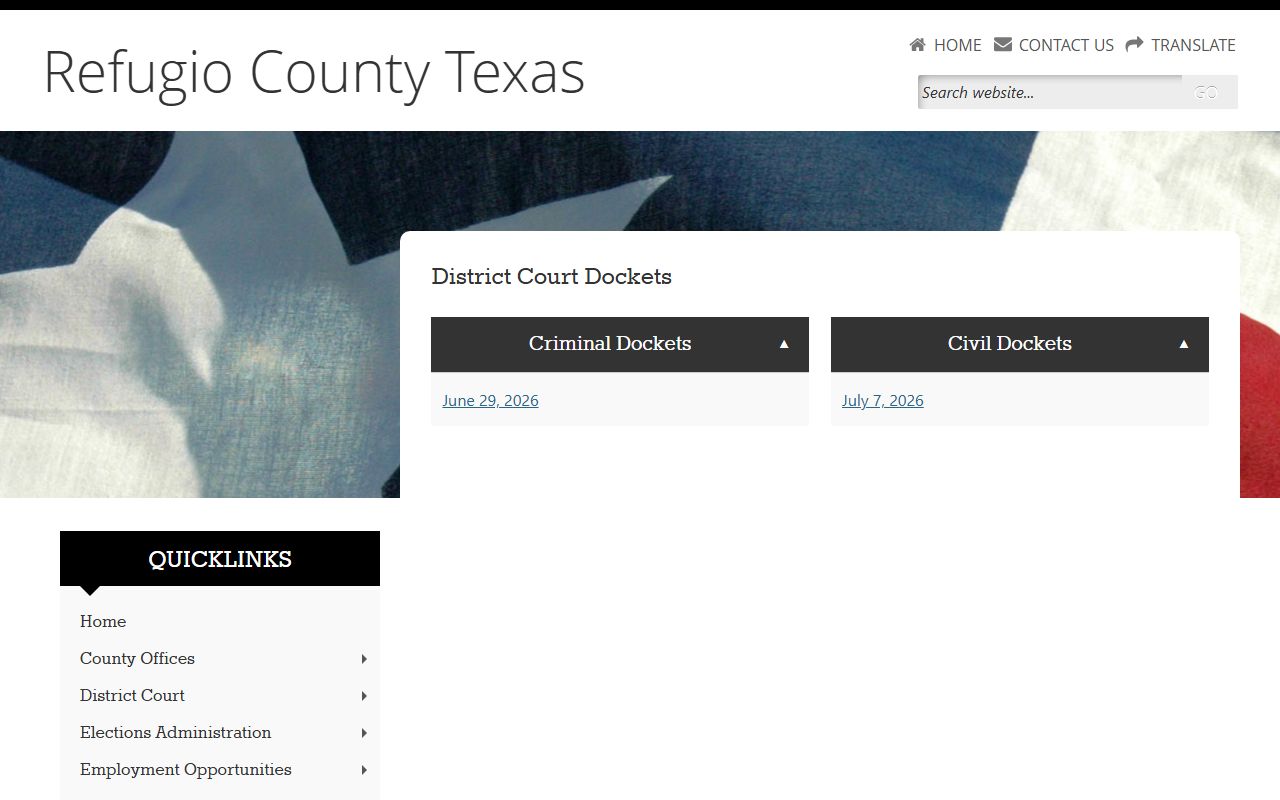
Docket postings should be read with the court and clerk contact information because settings can change.
Refugio County Court Search Fields
The research file identified a GovRec snippet for Refugio County stating that future court dates can be searched through a Criminal Search tab by name and date of birth or by ticket number. The official county records vendor also has search fields, but that system is for official records such as property records and document searches, not a complete jail-arrest criminal case roster.
| Search Path | Field | Use | Notes |
|---|---|---|---|
| GovRec criminal search | Name and date of birth | Future court dates or criminal search per snippet | Snippet lists 361-526-4877 for future court-date help. |
| GovRec criminal search | Ticket number | Citation or ticket-based lookup | Use when the ticket number is known. |
| County official records search | Department, search term, date range | Official records search | Not a jail booking or criminal case roster. |
| Docket PDFs | Defendant name and docket date | District and county docket review | Confirm with the clerk because schedules can change. |
Charges Filed After Arrest
After a jail arrest, the court record starts to take shape when a charging document is filed or when a docket entry identifies the charge path. Texas cases may use a complaint, information, or indictment. The terms are easy to mix up. A complaint or booking charge is not the same thing as a final conviction, and an indictment does not mean guilt. It means a grand jury returned a formal felony accusation.
| Document | Plain Meaning | Common Use |
|---|---|---|
| Complaint | Sworn accusation or probable-cause charging basis | Lower-level cases and early charge records |
| Information | Prosecutor-filed charging instrument | Misdemeanors and some non-indictment matters |
| Indictment | Grand-jury charging instrument | Felony prosecution |
Refugio County Charge Status
Charge status can change after an arrest. Prosecutors can amend or reduce a charge. A court can dismiss a count. A person can enter a plea. A jury or judge can decide the case. A jail roster, if one existed online, would still be a custody record; the clerk and docket path is where the filed case status is checked.
| Status | What It Means |
|---|---|
| Pending | The charge or case has not been resolved. |
| Amended or reduced | The prosecutor or court changed the charge level or wording. |
| Dismissed | The charge ended without a conviction on that count. |
| Conviction | A plea, verdict, or finding resulted in guilt or adjudication. |
Bond Records After Arrest
Bond is part custody record and part court record. Refugio County Jail does not publish a bond schedule, accepted payment methods, or an online jail bond portal in the research file. Call the jail booking line to ask whether bond has been set, whether a hold exists, which authority accepts payment, and whether magistration must occur first. For filed cases, confirm the correct clerk or court.
| Bond Term | Meaning |
|---|---|
| Cash bond | Money posted directly with the proper authority. |
| Surety bond | A licensed bond company posts the bond for a fee and contract. |
| Personal or PR bond | Release on a promise to appear, subject to conditions. |
| No-bond hold | A warrant, parole hold, detainer, or court order prevents release. |
Refugio County Prosecutor Contacts
The District Attorney page lists Brian M. Cromeens with a main office at 307 N. Gonzales, Cuero, TX 77954, phone 361-275-2612, and a Refugio office at 808 Commerce Street, Room 200, Refugio, TX 78377, phone 361-526-1282. The County Attorney page identifies Simon McCloud III at 808 Commerce Street, Room 108, Refugio, TX 78377, phone 361-526-4123. Prosecutor offices are not jail roster offices. They handle charge decisions and court prosecution, not routine custody confirmation.
The official District Attorney page is useful when a felony or district-level prosecution is involved.
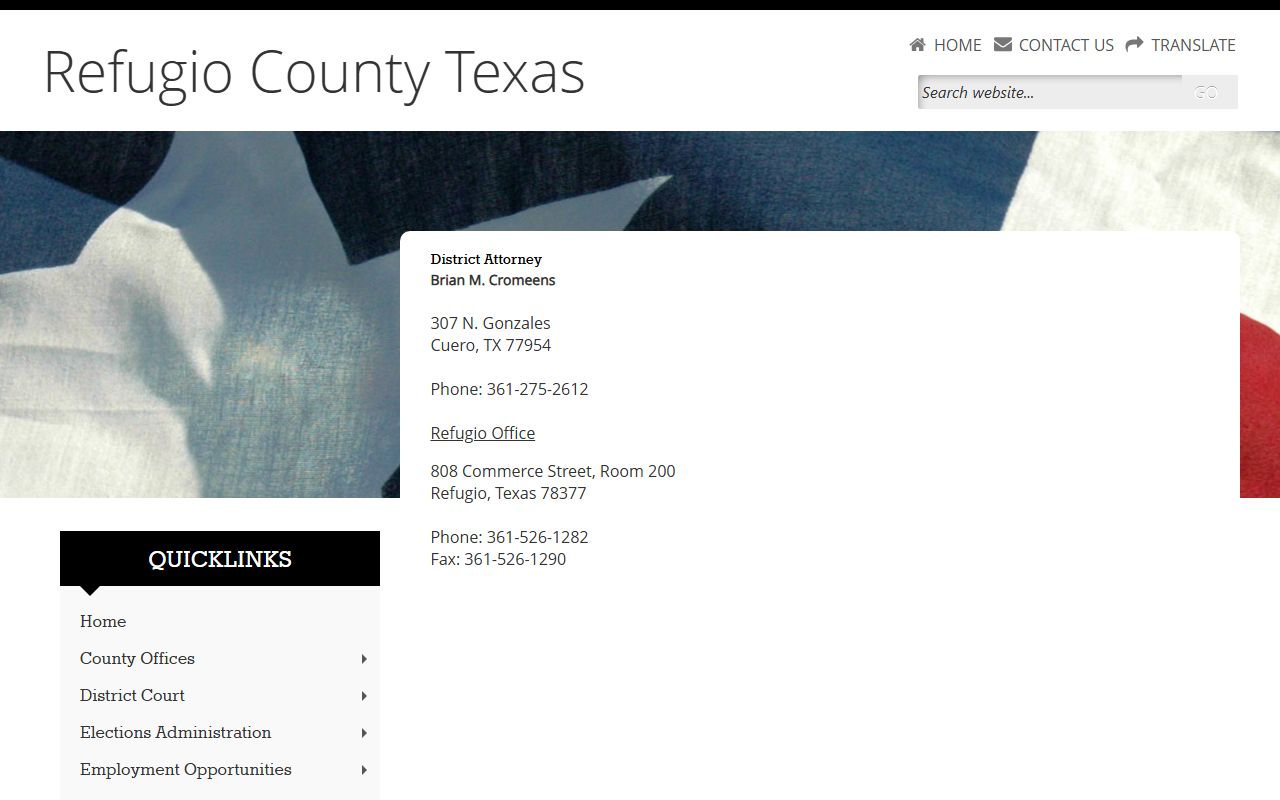
Use court records and clerk data to identify the actual case before contacting a prosecutor office about a specific matter.
Warrants and Court Records
No official Refugio County active-warrant search or sheriff warrant list was located. A warrant lookup should go through the issuing court, sheriff, or clerk. If a warrant caused a booking, call the jail for custody status. If the warrant is tied to a court case, the clerk or docket may show settings, bond-returnable dockets, or case entries.
Texas Code of Criminal Procedure Chapter 15 includes public-access rules for executed warrant affidavits, with confidentiality exceptions. Do not assume a pending warrant document is public in full. The practical step is to ask the issuing court what record exists, whether the person should consult counsel, and whether any bond or appearance process is available.
Charges vs Convictions
An arrest and charge are accusations or custody events. A conviction is a formal result after a plea, verdict, or adjudication. This difference matters for court records after a jail arrest because public docket entries may show many steps before the case is final.
| Issue | Charge | Conviction |
|---|---|---|
| Stage | Accusation filed or listed | Final or formal finding |
| Proof level | Based on probable cause or prosecutor filing | Based on plea, verdict, or legal adjudication |
| Case effect | Can be amended, reduced, or dismissed | Can carry sentence, fine, probation, or collateral effects |
Sealed and Expunged Records
Texas has different paths for limiting public access to criminal records. Expunction under Texas Code of Criminal Procedure Chapter 55 can remove qualifying arrest records. Nondisclosure can restrict public disclosure of certain criminal history records. The District Clerk page links expunction information, which is relevant when a Refugio County arrest ends in a qualifying way.
| Path | Effect | Common Trigger |
|---|---|---|
| Expunction | Qualifying records may be removed or treated as not existing for many purposes. | Eligible dismissal, acquittal, or other qualifying result. |
| Nondisclosure | Public access is limited, though some agencies may retain access. | Certain eligible dispositions under Texas law. |
Public Access Limits
Texas Government Code Chapter 552 gives the public a way to inspect or copy government records unless an exception applies. Court records, jail records, prosecutor records, and law-enforcement records do not all have the same rules. Juvenile records, sealed records, expunged records, active investigations, victim information, medical data, and court-restricted records may be withheld or redacted.
Important: Public court records after arrest should be verified with the clerk, court, or agency that created the record.
Public Record Search
Sponsored Results